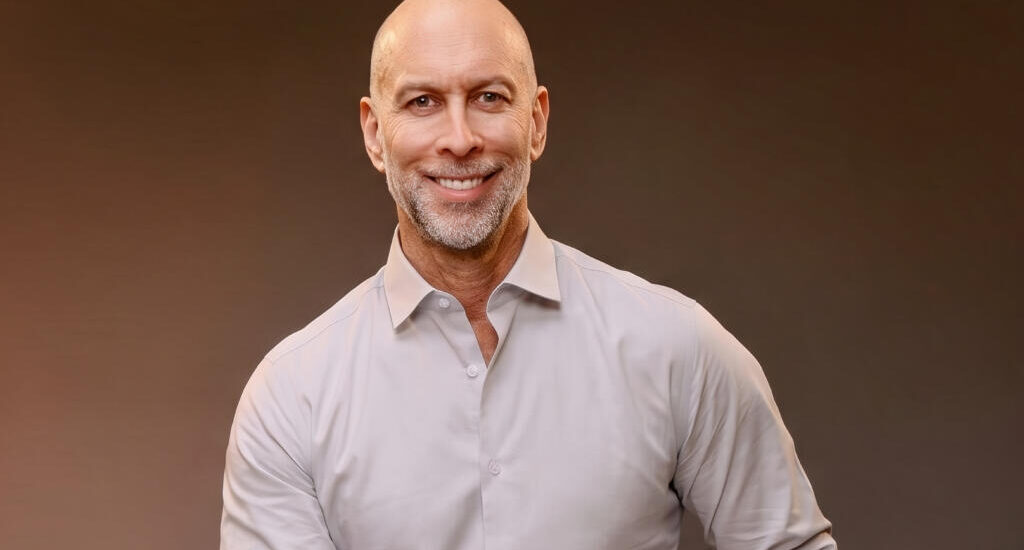
Jason Harvey
EVP & General Manager, BET+
Jason Harvey sits at the intersection of culture, technology, and storytelling, but his path there started far from boardrooms and streaming platforms.
From leaving home at 15 to leading what he calls “the largest streaming platform dedicated to Black storytelling,” his journey is built on resilience, data, and a relentless belief in betting on yourself.
Now, as he helps shape BET+ and the future of Black content, he’s also thinking about what comes next, for the industry, for creators, and for the next generation coming up behind him.
For those who aren’t familiar, what is your role at BET+ and what have you built?
I’m the EVP and General Manager of BET+, which is the largest streaming platform dedicated to Black storytelling.
I sit at this intersection of technology, entertainment, storytelling, and culture. My role is more than just programming. It’s about building a platform that reflects the full spectrum of Black life while also pushing innovation forward in an evolving media landscape.
We scaled from zero to 35 million unique users and 2 billion hours viewed. By cutting churn by 40% and growing LTV by 81%, we proved that knowing your audience specifically is a better business model than knowing them generally. This is what it means to sit at the intersection of culture and technology: culture is the algorithm.
My journey hasn’t been linear. I’ve spent time across Google, Microsoft, eBay, always at that intersection of creativity, strategy, and technology. BET+ is really the culmination of all of that, a place where I can scale impact with creators and storytellers and build something meaningful in the ecosystem.
You didn’t just land here. What was the path that led you to this point?
Definitely not linear.
I was in the Peace Corps in Ecuador, helping start microlending for women building community banks. I worked in automotive. Then an ad agency, which was a grind I wasn’t ready for.
Then I moved into ad tech at Google in Latin America. That came from my time in the Peace Corps where I learned Spanish, then later Portuguese when I worked at Microsoft in Brazil.
I ended up at a startup called Loot Crate, a subscription box company, which gave me deep experience in D2C. That’s what led me to BET+, because BET was shifting from linear cable into streaming and needed someone to help build that infrastructure.
I entered as a consultant and immediately saw a mismatch: a subscription business still running brand marketing playbooks. They were trying to acquire users through cultural campaigns, when the real game was retention—understanding who stays, why they stay, and what keeps them coming back at 11 p.m. on a Tuesday.
I helped rebuild the infrastructure from the ground up: performance marketing over brand marketing, lifecycle architecture over newsletters, and data science over spreadsheets. What most people saw as a streaming platform, I saw as a first-party data company with incredible IP. That reframe changed everything about how we operated.
What are the biggest life lessons that shaped how you operate now?
Be yourself. Bet on yourself.
There are going to be rooms where people don’t fully see you or understand your vision. That’s not the time to shrink. That’s the time to execute.
I came from nothing. My mother was addicted to drugs. I left home at 15. I had imposter syndrome in rooms at Google, in boardrooms, everywhere.
But I knew I did the work. I stayed consistent. I stayed authentic. And that’s what allowed me to grow.
That background is exactly why I made a specific decision at BET+: we built our data infrastructure from scratch instead of buying off-the-shelf. Every vendor we evaluated offered products designed for general audiences; their architecture assumed a ‘default’ viewer that simply wasn’t ours.
I had learned personally, not just theoretically, the cost of depending on systems that weren’t built for us. So, we built our own. Sixty trillion first-party data points later, that decision has paid off. When you know what it feels like to be underserved by infrastructure, you don’t build infrastructure that underserves people.
Now vulnerability is more accepted. Back then it wasn’t. So my advice is simple, just be yourself and keep doubling down.
For someone coming from a broken situation, what do they need to hear right now?
Find your people—and I mean that literally. For me, it started with a coach and a mentor at Ford Motor Company who saw potential I wasn’t even advertising. Eventually, it led to the Peace Corps, which gave me language skills, cross-cultural fluency, and a network of peers who had also chosen the harder path.
None of that was handed to me. I had to show up, stay consistent, and trust that doing the work in the right direction would eventually put me in the rooms where the right people could see it. What I know now is this: your circumstances are not your ceiling. But you do have to move. Waiting for permission is a strategy that works exactly never.
You might not have resources. You might not have access. But there are people who want to help you succeed. You just have to take that step and find them.
You’re known for using data to guide decisions. What is the data actually telling you right now?
Drama and thrillers perform incredibly well, especially on the movie side.
But I’m really excited about sci-fi. It hasn’t been done well for our audience yet. The data shows there’s opportunity.
Romantic comedies also show demand.
And then children’s animation is a big one. I have four kids, so I know this problem personally—but the data confirms it systematically: representation in children’s IP is a retention driver. Parents make viewing decisions based on whether their children see themselves on screen.
Anime is the category I’m most convicted about. It isn’t a trend; it’s a cultural arbitrage play. We saw a meaningful percentage of our younger BET+ subscribers consuming anime on other platforms every single week while we had zero inventory in that space. That is a massive market gap with a clear data trail. Black audiences are deeply engaged with anime. The question now is who will build the bridge between those two cultural identities in a way that feels authentic to both. That is a massive creative and business opportunity, and it hasn’t been claimed yet.
And then there’s this opportunity to blend formats. Scripted storytelling mixed with digital-native storytelling, influenced by how people consume content on social.
What about microdramas and vertical storytelling? Is that something you’re looking at?
The right frame here isn’t whether micro-dramas are interesting; the right frame is whether vertical storytelling holds a different meaning for this specific audience than it does for a general one—and I believe it does.
Our viewers grew up with short-form content as their primary mode of entertainment, which fundamentally changes their narrative expectations. A 90-second episode is a native format for a Black audience that grew up on Vine, Instagram video, and Twitter threads. The real challenge is whether we can build authentic storytelling within that framework, rather than just repurposing formats designed elsewhere.
BET is definitely looking at vertical scripted formats.
For BET+, we’ve historically focused on lean-back experiences, long-form content where you sit and watch for 30 minutes, 90 minutes.
But that’s changing. Attention is evolving.
Microdramas are part of that evolution, but the key is making sure the storytelling still feels grounded, authentic, and relevant.
We’re not chasing trends. We’re adapting to where the audience is going.
If a creator wants to work with BET or BET+, what should they actually do?
Create.
We’re in a democratized era of creativity. Anyone can make something now. So build a body of work. Know your audience and build specifically for them.
Don’t try to be everything to everyone. You’ll get washed out.
Don’t wait for permission.
Relationships matter too. Go to festivals, conferences, meet people. It’s easier to take meetings when there’s a face behind the name.
And make sure what you’re doing is specific. Generic doesn’t cut through anymore.
The best pitch I’ve ever received came from a creator who had no industry relationships, no agent, and had never been in a writers’ room. However, they had been building for a specific audience consistently for two years, and they could show me the retention.
Not the follower count—the retention. They showed me how many people came back every week, why they came back, and what those people were saying. That told me more about their ability to sustain a series than any treatment ever could. That is the currency that moves decisions now: build the audience first, and the door opens differently.
What advice would you give now that you wouldn’t have given even two years ago?
Two years ago, I would have told creators to master the craft first and let the business follow—to build your skills, find your voice, and worry about monetization later. I don’t believe that anymore.
The market is moving too fast for sequential learning. The window between cultural relevance and commercial opportunity is compressing; what used to be an 18-month cycle is now closer to six. If you don’t understand the business fundamentals of rights ownership, audience economics, and how a green-light decision is made, someone else will have built the platform you were hoping to join by the time you’ve mastered the craft.
Master both simultaneously. It’s harder, but the ones who figure it out are building careers that don’t depend on someone else’s permission. And right now, that’s the only kind of career worth building.
You can reach Jason Harvey via LinkedIn.