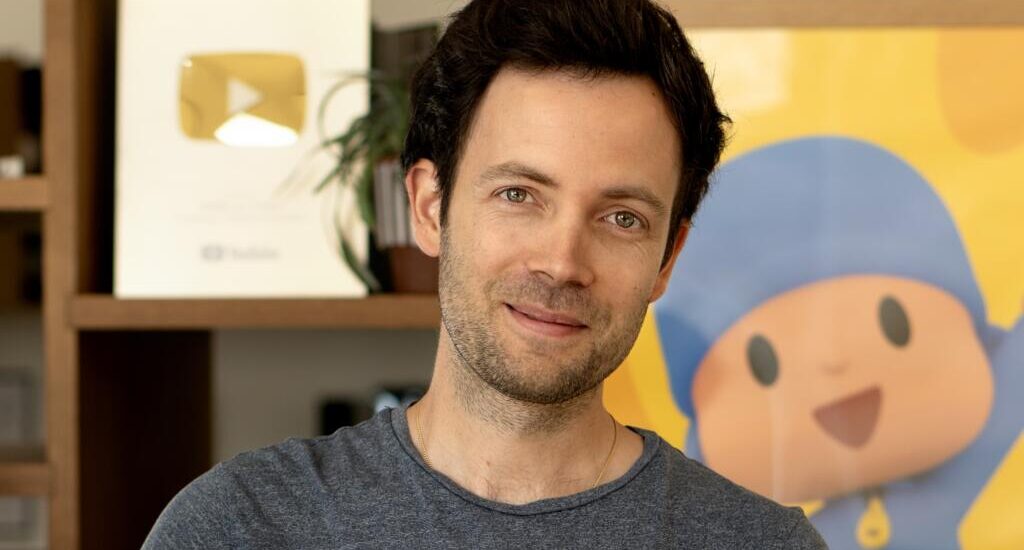
Sixte de Vauplane
Co-Founder & CEO, Animaj
For decades the kids’ animation industry followed the same broken playbook. Pitch a show. Wait years for a broadcaster. Produce 52 episodes. Hope it works.
Sixte de Vauplane believes that model is over.
As the co-founder of Animaj, he’s building what he calls a next-generation kids’ media company. One that starts on YouTube, uses real-time audience data to shape storytelling, and leverages AI to produce faster without sacrificing the creative vision behind the work.
Instead of waiting years for a greenlight, Animaj is focused on building global franchises where the audience already lives — and where the money is already going. YouTube.
For people who are not familiar with you or Animaj, tell us about the company.
Animaj is a next-generation kids’ media company built around a single, simple truth: the next generation of kids isn’t watching television.
Kids are not waiting for Saturday morning anymore. They are on YouTube. They are on Roblox. They are on digital platforms.
So the entire playbook for building kids’ franchises needs to change.
Our goal is to build the next generation of global kids’ brands using a digital-first, AI-powered approach. We use data to understand what kids are watching and how they engage with content, and we produce shows designed for those platforms from the beginning.
Your co-founder also comes from YouTube Kids. How did that partnership shape the company?
My co-founder Gregory Dray was the former Managing Director, International, YouTube Kids & EMEA Kids, Family and Education, and had spearheaded the global expansion of YouTube Kids over the past decade.
When we met, we both believed there was a new playbook emerging for children’s media.
Instead of building shows for television first, we start where kids actually watch content today. YouTube becomes the launchpad, and AI becomes the enabler.
Once an audience is established, we expand the IP through consumer products, music, licensing, and other media extensions.
Why focus specifically on kids and animation?
Part of it is personal. I’m a father of four children under seven, and I saw firsthand how different their media consumption habits are.
But there is also a huge opportunity. Kids’ animation is one of the areas where AI can dramatically accelerate production while still maintaining quality. Animation has always relied on computers to generate images. AI simply speeds up that process and allows creators to move faster.
At the same time, we are very focused on using AI responsibly. There is a lot of debate about low-quality AI content online. Our goal is the opposite. To raise the quality of what kids are watching.
What has changed in the kids’ entertainment marketplace over the last few years?
The biggest shift is distribution. YouTube has become the dominant platform for children’s content. Hundreds of millions of viewers watch kids and family videos every month.
As a result, advertising dollars have shifted from traditional television to digital platforms. That means broadcasters no longer have the same budgets to fund shows the way they used to.
So if you want to build a kids’ franchise today, you have to start where the audience and the money already are.
How does Animaj actually work with creators and intellectual property?
We usually operate in two ways. First, we acquire or co-own existing intellectual property. For example, we partnered with Studio 100 – one of Europe’s most powerful kids’ content producers – to co-own the Maya the Bee brand and relaunch it using our approach
The second is co-developing entirely new IP directly with creators, writers, and studios; built digital-first from day one Either way, the goal is the same: build strong franchises that can grow across every platforms, everywhere kids are.
What advice would you give creators trying to break through today?
Don’t wait for someone to buy your show. Create it yourself.
Platforms like YouTube allow you to bypass traditional gatekeepers. If you have a strong idea, you can start publishing episodes immediately and begin building an audience.
Once you have data and engagement metrics, you have far more leverage when you approach buyers later.
What kind of content length works best when launching a new show online?
It depends on the format, but we often experiment with episodes around two minutes long.
That length is short enough to work well online but still allows for narrative storytelling. Many of our shows are also music-driven, which helps maintain attention and engagement.
You’ve talked about using audience data to shape storytelling. How does that work in practice?
The traditional Hollywood model is very top-down. Creators spend years developing a show before anyone sees it.
On YouTube, the process becomes bottom-up.
You release an episode. You watch how the audience reacts. Where do they laugh. Where do they drop off. Which characters resonate.
Then the next episode improves based on what you learned.
Each episode becomes five or ten percent better than the last. Over time that compounds dramatically.
But one thing is critical in that process.
Data should inform creativity, not replace it. At the end of the day, great storytelling are the ones deeply personal and driven by a human creative vision. That’s what separates content kids love from content that just fills a feed.
Looking ahead, where do you see the industry going in the next few years?
AI will continue to accelerate across the media industry. Within the next couple of years we will likely see the first fully AI-produced feature films reaching audiences.
But what excites me even more is interactive storytelling.
New technologies are beginning to blur the lines between linear content and gaming. Instead of simply watching a story, audiences may be able to participate in it.
For creators and IP owners that opens entirely new opportunities for storytelling and monetization.