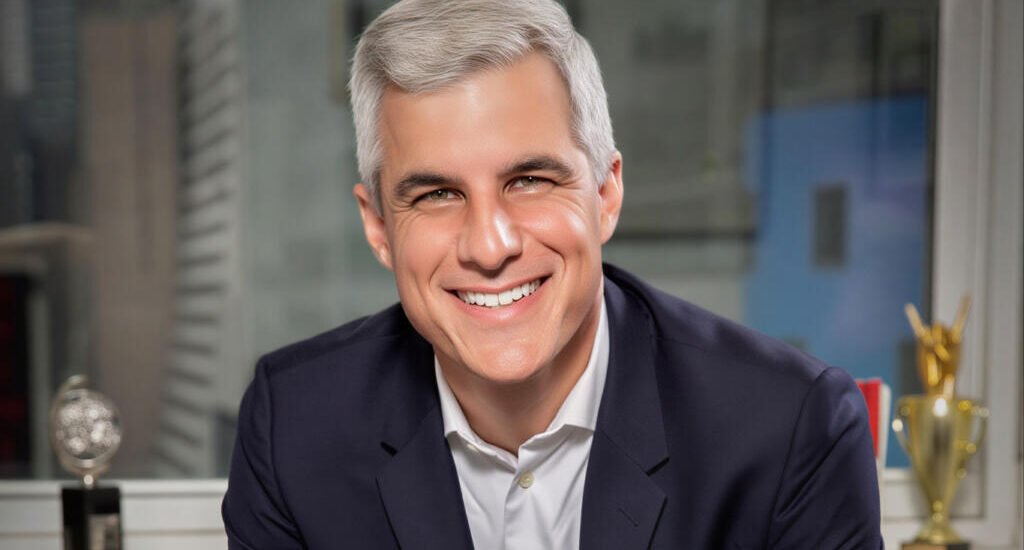
Ken Davenport
Broadway Producer
Most people think Broadway starts with talent. Ken Davenport knows it starts with a sale.
For over 30 years, he’s built a career producing shows by doing something most creatives avoid at all costs. Raising money. Selling the vision. Getting people to believe before anything exists.
While others wait to be discovered, he teaches creators to think like founders, not artists. Because in his world, no one is coming to save your project.
For those who aren’t familiar with you, tell us what you do.
I’m a Broadway producer and I’ve been working in professional theater for over 30 years.
I started as a production assistant getting coffee and sandwiches for the creative team. Then I worked my way up through stage management, company management, and general management.
Eventually I started writing and producing my own shows, and that led me to where I am today.
What is it about theater that keeps you passionate after all these years?
Theater is one of the oldest art forms in the world.
People gathering together in a room to hear a story. That’s something we’ve been doing forever.
People always say theater is dying, but it’s survived everything. Plagues. Radio. Television. The internet.
And the more digital and isolated entertainment becomes, the more valuable that live communal experience becomes.
There’s nothing like being in a room with hundreds or thousands of people all reacting at the same time. That feeling never goes away.
Walk us through what you actually do as a producer.
Our job is to create and produce Broadway shows.
Sometimes that starts with an idea. For example, I’m developing a musical based on the Vacation film franchise where the Griswold family comes to New York.
Other times it’s based on a real person or existing IP. I also developed a musical about Joy Mangano, the inventor of the Miracle Mop.
But ideas alone don’t make shows happen. You need capital.
And Broadway producers are different from most producers because we actually raise the money ourselves. There’s no studio writing the check.
If we don’t raise the money, the show doesn’t exist.
You’ve built a reputation around raising capital. What are the core skills behind that?
At the end of the day, it’s sales.
People don’t like that word, but every successful business depends on it.
You have to be able to get people excited about what you’re doing.
The difference for me is I can’t sell something I don’t believe in. But when I love a project, I can go all in. I can communicate why it matters and why it should exist in the world.
That passion is what brings people in.
How do you identify the right investors for something like a Broadway show?
The first thing is simple. Do they love theater?
If they don’t, they shouldn’t be investing in it.
This is what I call passion investing. Theater, film, restaurants, art. These are high-risk investments, so the emotional return matters just as much as the financial return.
You’re not just buying a return. You’re supporting something you want to exist in the world.
And how should people think about the financial side of that?
You have to assume you may not see the money again. That’s the mindset.
It’s like buying a piece of art. You hope it goes up in value, but you’re also buying it because you want it on your wall.
Same with theater. You’re investing because you believe in the story, the message, the creator.
If it succeeds financially, that’s great. But that can’t be the only reason you’re doing it.
For creators trying to break in, what are they getting wrong?
They’re waiting. They’re asking, “How do I find a producer?”
That’s the wrong question. You need to think of yourself as the founder of a startup.
Founders don’t wait for someone to fund their idea before they build anything. They create a version of the product and put it into the world.
Theater is meant to be seen, not read. A script on a page isn’t enough.
You have to find a way to get it up. Even if it’s small. Even if you have to raise some money yourself.
Once people can see it, then things start to move.
You’ve also started exploring film. What’s driving that move?
A lot of our investors have asked about it, so we’ve started to explore the space. But I’m very aware of what I don’t know.
We’re taking small steps. Reading projects. Talking to people. Making selective investments.
I love learning new things, and film is a natural extension, especially for projects that have a connection to theater.
You talk a lot about putting things out into the world. Why is that so important?
Because you never know what comes back. You put an idea out there, and suddenly the right people find you.
Writers you admire reach out. Opportunities appear that you couldn’t have predicted.
I always say entrepreneurs have one job. Serve the ball. Start the game. Put something into the world and let it come back to you.
That’s how things get made.